Buyer guide · Market insight
When does a building inspection have the most negotiating power?
The technical value of an inspection is constant. Its negotiating value changes with the property market.
Reviewed by Xiaoqiong Yang, Building Inspector (Limited), IN-L 100094.
A pre-purchase building inspection is useful in every market. It can identify visible defects, moisture concerns, timber-pest evidence or risk factors, unsafe conditions and areas that could not be properly accessed.
But the same report can have very different commercial value at different points in the property cycle.
In a strong seller's market, an inspection may protect you from buying the wrong house but give you limited room to negotiate. The vendor may have several other buyers waiting, some willing to sign unconditionally.
In a softer market, the balance changes. If the property has been listed for longer, buyer finance is tighter and the vendor cannot easily replace a serious purchaser, documented defects become much harder to dismiss.
The short answer
A building inspection usually has its greatest negotiating value during the transition from a seller's market to a buyer's market.
At that point:
- vendors may still be anchored to yesterday's price;
- fewer buyers may be able to borrow at the old level;
- listings can take longer to convert;
- buyers have more comparable properties to choose from; and
- losing one credible buyer may mean another campaign, another delay and no certainty that the next offer will be better.
The report does not create bargaining power by itself. The market makes the findings expensive for the seller to ignore.

How inspection value changes through the market cycle
| Market stage | Main value of the inspection | Typical negotiating power |
|---|---|---|
| Hot seller's market | Avoiding a bad purchase and understanding risk before competing | Limited, because another buyer may accept the property as-is |
| Cooling or transitional market | Identifying defects while vendors are still adjusting expectations | Often strongest, because the seller may not want to lose a qualified buyer |
| Established buyer's market | Risk control plus evidence for price, terms or further investigation | Strong, although obvious defects may already be reflected in the asking price |
| Early recovery | Protecting against renewed urgency and fear of missing out | Starts to reduce as buyer competition returns |
This is why asking only, “Does the house have defects?” misses half the value of an inspection. The second question is: how difficult would it be for this vendor to replace me if I walked away?
Dated analysis
Market context — 3 October 2026
These conditions can change. The date is prominent so the evidence can be reassessed without presenting old data as current.
Borrowing conditions are tighter
On 29 September 2026, the Reserve Bank of Australia increased the cash-rate target by 25 basis points to 4.60%. It also noted that housing prices had fallen in most capital cities and new housing loans had declined noticeably.1
Higher rates reduce borrowing capacity and increase repayment sensitivity. For a seller, a buyer with finance, genuine intent and a realistic settlement plan can therefore be more valuable than the number of online views suggests.
Inflation is still consuming household capacity
The ABS reported annual CPI inflation of 4.0% in August 2026. Housing rose 5.7%, while new-dwelling prices rose 5.4% as labour and material costs were passed through.2
Buyers are assessing more than the mortgage. Insurance, energy, maintenance and rectification work all compete for the same household budget, so a leaking roof, failed wet-area seal or poor stormwater arrangement has an immediate budget consequence.
Global uncertainty can keep inflation and confidence unstable
The RBA identified international conflict, energy-price pressure and the possibility of weaker global growth as material uncertainties.1Higher input costs can keep inflation and rates elevated, while weaker growth can reduce buyer confidence and transaction activity.
Neither outcome makes every home cheaper. It does make buyers more selective and makes a dependable transaction more valuable to sellers.
Victoria carries additional property-policy and holding-cost pressure
Victorian property owners and investors face measures including the temporary COVID Debt Repayment Plan land-tax surcharge and, where relevant, vacant residential land tax.56These do not determine the value of an individual home, but they can affect holding costs and some owners' willingness to wait indefinitely for a preferred price.
The Victorian state election is scheduled for 28 November 2026.4An election does not automatically cause prices to fall, but uncertainty about future settings can lead some households and investors to postpone a major decision.
Migration remains important, but it is not automatic support for every property
Australia's 2026–27 permanent migration planning level is 185,000. Home Affairs also reports that net overseas migration has fallen by more than 40% from its 2023 peak and describes the program as more focused on people already in Australia.3
This is not the end of migration-driven housing demand. It means buyers and sellers should not assume population growth will support every suburb, property type and price point equally.
What changes when a seller can no longer take the buyer for granted?
In a very strong market, a vendor can respond to an inspection concern with: “The property is being sold as-is. There are other buyers.” That response is commercially rational when it is true.
In a softer market, the seller has to consider different questions:
- If this buyer leaves, how long will it take to find another?
- Will the next buyer's finance be as strong?
- Will the same defect be raised again?
- Will a failed transaction make the listing look stale?
- What will another month of interest, advertising and holding costs mean?
The important shift is not that every seller becomes desperate. It is that the cost of losing a credible buyer rises.
Real buyer case · Carrum Downs
The buyer used documented defects and a repair estimate to negotiate from evidence, not fear.
This Carrum Downs case involved an occupied single-level brick-veneer unit. The suburb is included as useful local context; the buyer's name, street address, original inspection company name and all report identifiers have been removed.
The inspection established a connected defect story
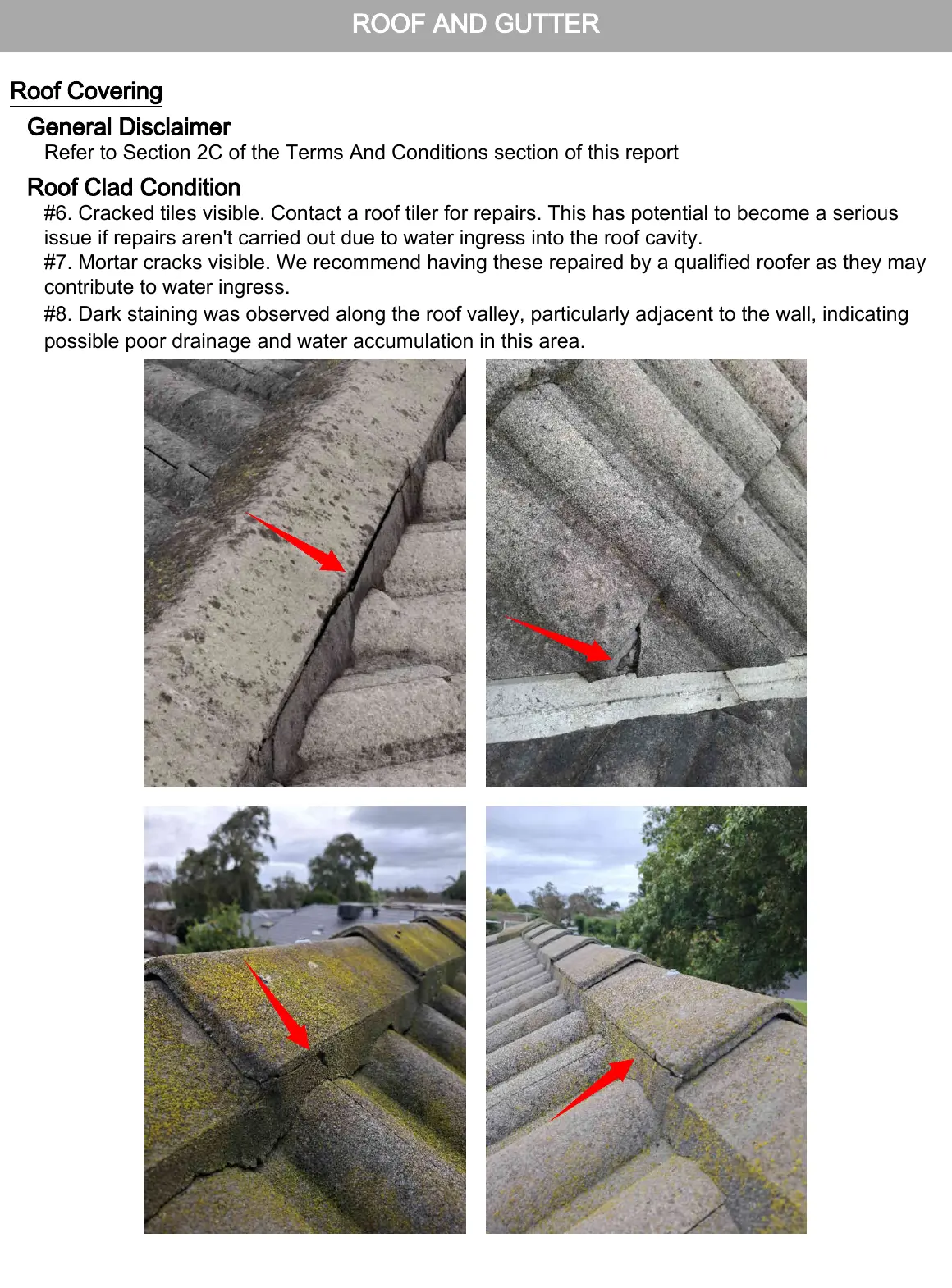
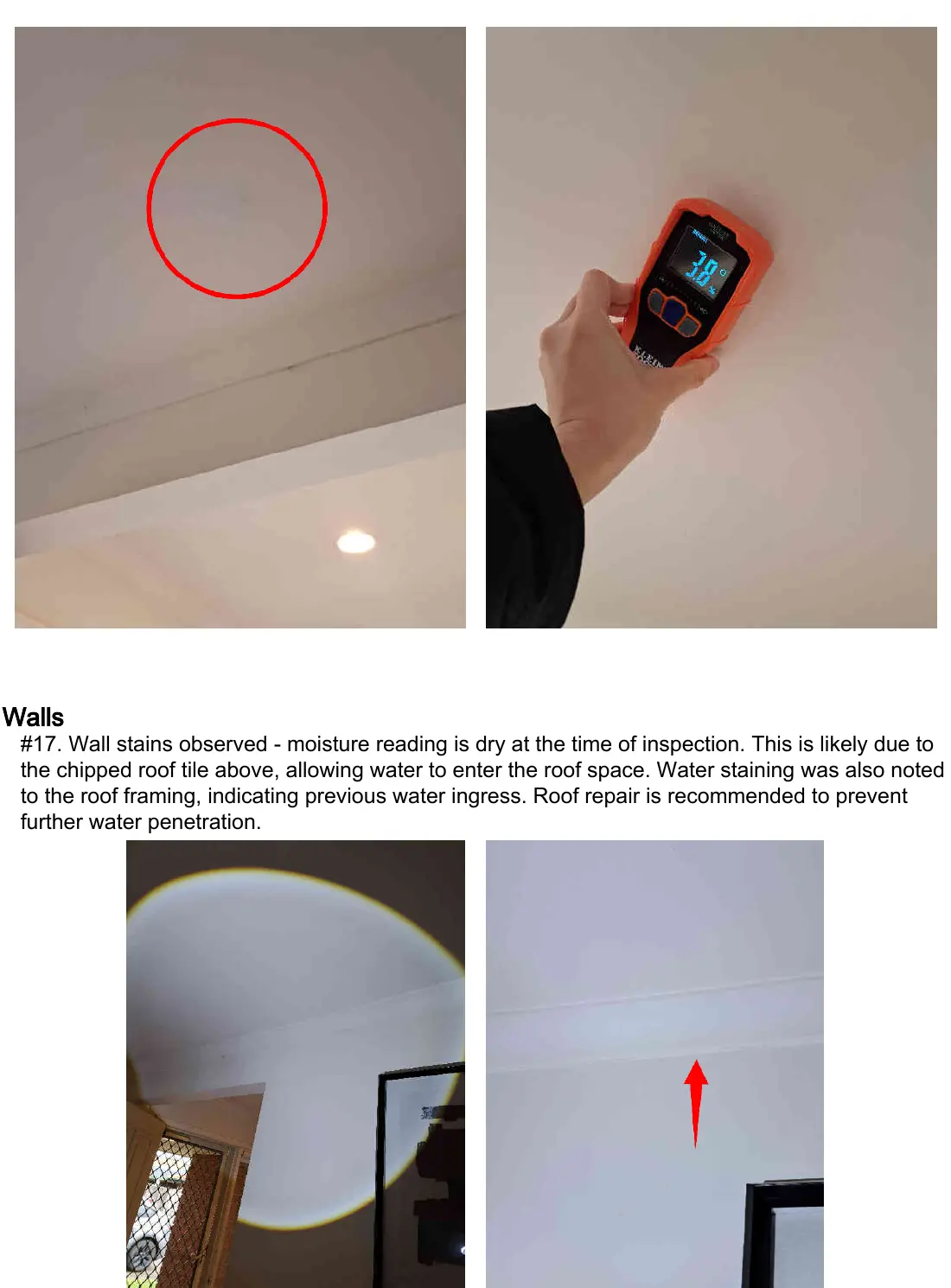
The report recorded cracked roof tiles, deteriorated ridge mortar and staining near a roof valley. Inside, staining to the dining-room wall and roof framing indicated previous water entry. Bathroom moisture, drainage defects and other maintenance items were also documented.
The findings were translated into a repair allowance
A standard visual inspection report does not price building work. After the inspection, we helped the buyer separate the priority items from ordinary maintenance and prepare an estimated repair budget for her purchasing decision.
The buyer secured a vendor discount and kept control
Using the documented findings together with that estimate, the buyer obtained a discount from the vendor. She moved in 30 days later and chose to complete only the repairs she considered priorities.
Why the outcome matters
The discount gave the buyer options; it did not dictate the repairs.
Choosing to defer some work did not make the findings disappear. It meant the buyer could decide what to repair first, while the negotiated discount provided a budget buffer if the remaining items required attention later.
One real outcome, not a promise: every property, contract, vendor and negotiation is different. Inspection findings do not guarantee a discount. Contract rights and negotiation strategy should be discussed with the buyer's conveyancer or representative.
An inspection is strongest when it is arranged at the right time
Negotiating value depends on timing and contract wording. For an auction purchase, the inspection will usually need to be completed before bidding because an auction contract is commonly unconditional.
For a private sale, a buyer may inspect before making an offer or rely on a properly drafted building-and-pest condition. The wording, deadlines and rights created by that condition are legal matters and should be reviewed by a conveyancer before the contract is signed.
An inspection completed after the buyer has lost the contractual ability to respond may still help with repair planning, but much of its negotiating value may already have disappeared.
How to use the report without overplaying your hand
Turning every minor defect into a demand for a discount can weaken a buyer's credibility. A better process is:
- Arrange the inspection early enough to preserve your options.
- Read the scope and access limitations, not only the defect summary.
- Separate safety, moisture, structural and timber-pest concerns from ordinary age and maintenance.
- Obtain specialist or trade advice where the evidence warrants it.
- Decide what the findings mean to you: proceed, investigate further, negotiate, change terms or withdraw where legally available.
- Use your conveyancer or buyer's advocate for contract and negotiation strategy.
A building inspector reports on accessible visible conditions. The inspector does not decide the property's market value and should not replace legal, engineering or specialist advice.
Not every property is a buyer's-market property
Even in a broad downturn, a well-located home with realistic pricing and scarce features may attract several buyers. A soft Melbourne index does not guarantee a discount on a particular house.
That is another reason to inspect. If the seller has genuine competition, the report helps you decide whether the property is worth pursuing despite the risk. If there is little competition, the same report may also help you negotiate from evidence rather than emotion.
The real value of inspecting in a difficult market
A slower market does not make defects more severe. It changes who has to absorb their cost. When qualified buyers are scarce, the assumption that a vendor can simply pass a problem to the next purchaser becomes weaker.
This is the stage in which an inspection can be most commercially effective:
- the buyer has time to investigate;
- alternative properties exist;
- repair costs matter more;
- the vendor values certainty; and
- walking away is a credible option.
The best inspection report does not tell you to buy or not to buy. It gives you better evidence at the moment when evidence has the greatest negotiating weight.
Frequently asked questions
Using an inspection in a property negotiation
Can a building inspection help negotiate the purchase price?
It can provide credible evidence for a negotiation, but it does not guarantee a price reduction. The result depends on the findings, competing buyer interest, the seller's position, contract wording and the advice of the buyer's conveyancer or representative.
When should I arrange a building inspection in Victoria?
Arrange it before you lose the ability to respond to the findings. For an auction, this commonly means before bidding. For a private sale, inspect before signing or obtain legal advice on an appropriate building-and-pest condition.
Is an inspection still worthwhile in a seller's market?
Yes. Its main value may be risk control rather than negotiation. It can help you avoid competing blindly for a property with significant visible defects or conditions requiring further investigation.
What defects create the most negotiating leverage?
There is no automatic list. Moisture entry, significant building defects, timber-pest evidence, unsafe conditions and expensive specialist investigations generally carry more weight than minor cosmetic or routine maintenance items. The market and the individual property still matter.
Does a building inspector recommend how much to offer?
No. A building inspection reports accessible visible conditions and limitations. Market value, contract rights and negotiation strategy should be considered with appropriately qualified property and legal advisers.
Primary sources
Market information used in this guide
- Reserve Bank of Australia — Monetary Policy Decision, 29 September 2026
- Australian Bureau of Statistics — Consumer Price Index, August 2026
- Department of Home Affairs — Permanent Migration Program planning levels
- Victorian Electoral Commission — 2026 state election
- State Revenue Office Victoria — COVID Debt Repayment Plan
- State Revenue Office Victoria — Vacant residential land tax
Market data was checked on 3 October 2026. General information only; it is not legal, financial or property-valuation advice.